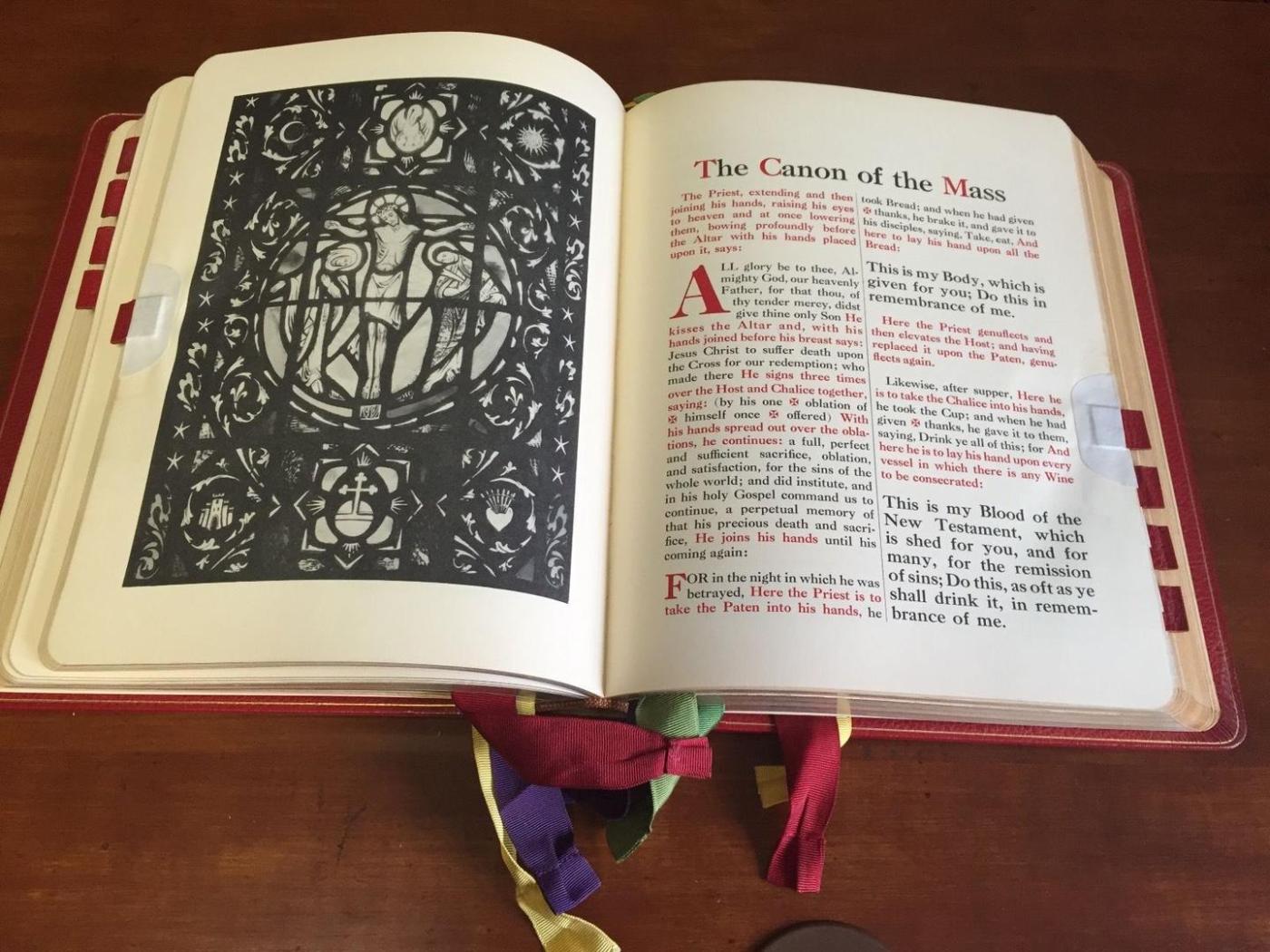
Throughout nearly 29 years of priestly ministry, I never considered the opening order of the Mass. Indeed, it never occurred to me to think about it until a couple months ago when doing supply work (often referred to somewhat irreverently as “visiting fireman.”) On that particular Sunday the choir began the Introit immediately after the Collect for Purity, just as I was about to read the Summary of the Law. (They also proceeded with the Kyrie so there was no place to really stick in the Summary.) I was a bit surprised but didn’t think anything about it until the next time I was serving in that place, the same thing happened. I checked their service leaflet and the pew missalette, and both had the Summary right after the Collect, so I chalked it up to just jumping the gun, but the experience kept nagging at me. Finally, being a well-trained academic, I sat down to some research. I started by thinking through the different combinations one could possible have. That gave me eight permutations:
- Collect for Purity – Introit – Summary of the Law
- Collect for Purity – Summary of the Law – Introit
- Collect for Purity – Introit or Summary of the Law
- Collect for Purity – Introit
- Collect for Purity and Summary of the Law during the Introit
- Introit – Collect for Purity – Summary of the Law
- Introit – Collect for Purity
- Collect for Purity – Summary of the Law – No Introit
The astute reader will have noticed that this list has eight elements, not thirteen. The other five one could arrive at by reversing the order to place the Collect for Purity after the Summary of the Law, but I could find no authority suggesting that, and indeed, no place where that reversal was practiced, so eight is where we begin.
In my priesthood, I’ve often found occasion to use the phrase “by the book,” by which I mean the counterpoint to the oft-encountered personal whim, what is often referred to as “WTVL,” or “what the vicar likes.” In conversation, however, when one says “by the book,” the snarky response is often “what book,” as if that ended the conversation (which it usually is intended to do.) To combat that line of thought, I consulted more than one book. Being a good Anglican Catholic, I began with the Book of Common Prayer, specifically the 1549.
This book, the original prayerbook, from before any protestantizing changes in the subsequent editions, is the standard BCP of at least one jurisdiction of continuing Anglicans. In this book, the Mass begins with the Collect for Purity, followed by the Introit. The Summary of the Law did not appear until the non-jurors’ liturgies of 1718 and 1764, which is whence it came into the American liturgy. This gave no real insight, so the search continued.
As I am American, I then turned to the American prayerbook, the current edition, 1928. The Introit having disappeared in the first protestant revision of 1552, it does not appear in the American 1928 BCP. The Collect for Purity is said, per the first rubric on page 67, “standing reverently before the Holy Table,” then follows the Decalogue (rubrically required once per month, but in most places always omitted) and the Summary of the Law (if the Decalogue has been omitted.) After the first rubric, no position or place is specified, so clergy usually consult reliable authorities for clearer directions to point the way.
The Anglican Missal prints the Collect for Purity and the Summary with a rubric permitting the Decalogue in between. The rubric preceding the Collect for Purity states that it is said by the priest “before he ascends to the Altar,” and “with the distinct (or, if the Introit be in singing, with the subdued) voice” (B6).[i]
The People’s edition of the same book yields a little more information. It prints the Collect for Purity and the Summary with nothing, not even a rubric, in between, but the rubric preceding the Collect for Purity states that both of these may be “said privately by the Priest as the Introit is sung, or even after the Introit, at the altar on the Missal side, although the foregoing [BCP] rubric seems to indicate that they are to be said at the foot of the Altar,” i.e., on the pavement.[ii] Too many options. Presumably the book was trying to be descriptive and give the majority of ways one might see it in practice.
However, the American Missal doesn’t share this broadmindedness. After the Collect for Purity, the rubric directs that the priest ascends to the altar and “reads the Introit of the Mass. The Introit being concluded, he reads the Summary of the Law” (239).[iii] Not only is an order specified, but the location as well. Alas, I determined to keep digging to find if there were any other authorities with this, or any other, advice.
My next source was a logical step: Ritual Notes. (“But which book” the interlocuter playfully whispers.) The oldest edition in common use is the ninth. In it I found that paragraph 495 specifies that Low Mass preparation ends with the Lord’s Prayer (optional) and then the Collect for Purity. This rubric goes on to say “…he then slowly ascends the steps while reciting the prayer, which he finishes as he gets to the middle of the altar” (222). This rubric has been mistakenly interpreted as referring to the Collect for Purity, and one may occasionally observe clergy ascending the steps during this collect. The note on this paragraph specifies that the “Lord’s Prayer and the Collect for Purity will be said in a loud voice before ascending to the altar.” (240). As the next paragraph, 496, deals with the Introit, it would seem clear that Cairncross expects the Collect for Purity to precede the Introit.[iv] Reading further, however, paragraph 526 gives an additional option that “In some churches it is customary for him to say the Lord’s Prayer and Collect for Purity while the choir are singing the Introit (in which case the choir, after finishing the Introit, at once begin the kyries)” (241). Not helpful. However, in contradiction to paragraph 526, 527 then states that the Lord’s Prayer and Collect for Purity at Sung Masses “should be said audibly to the congregation, between the sung Introit and sung kyries” (241). One should note that the Collect for Purity is not mentioned at all with regard to Solemn High Mass, which would seem to imply that it is either omitted or covered by the Introit. The Summary is not mentioned, of course, either because the text is not in the English books, or because it was not customarily said by catholic-minded clergy.
One might consult the next (10th) edition, from only ten years later, but it repeats the same instruction from the ninth edition with virtually no change.
Moving on to the current edition, however, things begin to clarify.[v] In the low Mass directions for the preparation, the celebrant says the Collect for Purity and “then slowly ascends the steps while reciting the prayer Take away from us…” thus making clear that “the prayer” in earlier editions does not refer to the Collect for Purity (125). At this point there is no direction about the decalogue or summary of the law, presumably for the same reasons as in the ninth and tenth editions. The high Mass directions place the Collect for Purity before ascending the altar (154), however, in a note is added “If the ten commandments (or the summary of the law) are read, the sacred ministers come into line one behind the other as soon as the celebrant has read the Introit” (156). The sung Mass chapter states in a note “If the ten commandments, or the summary of the law, are read, the celebrant does so after reading the Introit” (187). So the order we have here is Collect for Purity then the Introit, and finally the summary.
So far no consistency. Looking a bit farther afield I found the very handy manual for Holy Week that was published by the SSJE.[vi] This useful book gives the order Collect for Purity, Introit, then Summary of the Law.
Consulting books commonly found in the pew or home, I arrived at the Saint Augustine’s Prayer Books. The first edition, from 1947-1965 and republished in 2005 with the word “Traditional” prefixed to the title finishes the preparation with the Collect for Purity and gives the two private prayers as the priest ascends to and osculates the altar. The Introit rubric states that he then reads the Introit or the Summary.[vii] The revised edition of the book provides yet a different perspective, perhaps not as innovative as its predecessor. It finishes the (shortened) preparation with the Collect for Purity, immediately following with the Summary of the Law. The Introit rubric states that at said Mass the priest reads the Introit either after the Summary or before the Collect for Purity.[viii]
Another common resource, the venerable Practice of Religion, gives the order Introit, Collect for Purity, then Summary of the Law.[ix]
In desperation for some sense of consistency, I resorted to Archbishop Haverland’s admirable guide, Anglican Catholic Faith & Practice. In this book, he provides a detailed outline of the order of parts of the Mass, in which we find the opening rite at the foot of the altar, Collect for Purity followed immediately by the Summary or Decalogue, then at the altar the Introit, kyrie, and gloria.[x]
Unsatisfied with what I found, I then turned to the web to see what was actually being done “in the field,” as it were. Every parish for which I found a video of its Sunday Mass was following the pattern of Collect for Purity, then Introit, and finally the Summary of the Law. Thinking there was at last a consensus, I checked one last parish, and they didn’t have a video online, but they did have a collection of service leaflets. The practice there was—you guessed it—different. There the Introit followed the Summary of the Law. I threw my hands up. Well, metaphorically at least.
As an English professor, I always urge students to be concise. So to wrap things up in a succinct way, although it may be too late for that, if we were considering simply the number of authorities’ directions, it would appear that the order most commonly directed or advised is Collect for Purity (at the foot of the altar), followed by the Introit and then the Summary of the Law. Fortunately, this order is also what is overwhelmingly found in the parishes. I wasn’t happy merely with finding out “what,” though. I wanted to consider “why.” So, as for liturgical logic, I would say that the Introit, being an entrance hymn, should be regarded as the opening of the liturgy. However, when we find places and books with the Introit all over the place, there may be no real consideration about the function of these three parts, so I would suggest it best to consider the Collect for Purity as the finish of the preparatory prayers, the Introit as the entrance hymn, and as there seems to be no other justification for it, the Summary of the Law as an invariable Old Testament lesson.
[i] The Anglican Missal in the American Edition. (Athens, GA: Anglican Parishes Association, 1988), B6.
[ii] The People’s Anglican Missal in the American Edition. (Athens, GA: Anglican Parishes Association, 1988), B29.
[iii] The American Missal. Revised ed. 1951. (Macon, GA : All Saints Press, 1951) 239.
[iv] Henry Cairncross, ed. Ritual Notes. 9th edition. (Glendale, CO: Lancelot Andrews Press, 1946), 222-41.
[v] E.C.R. Lamburn, ed. Ritual Notes. 11th Ed. (Glendale, CO: Lancelot Andrews Press, 1964), 125-87.
[vi] An American Holy Week Manual. (Cambridge, Mass.: Society of Saint John the Evangelist, 1946), 10.
[vii] Traditional St. Augustine’s Prayer Book. (Athens, GA: Anglican Parishes Association, 2005), 57-58.
[viii] Saint Augustine’s Prayer Book. Revised ed. (West Park, NY: Holy Cross Publications, 1967), 61.
[ix] Archibald Campbell Knowles. The Practice of Religion. 7th ed. (NY: Morehouse-Barlow, 1966), 109.
[x] Mark Haverland. Anglican Catholic Faith & Practice. 3rd ed. (Athens, GA: Anglican Parishes Association, 2011), 85.
 Anglo-Catholic Central
Leave a comment